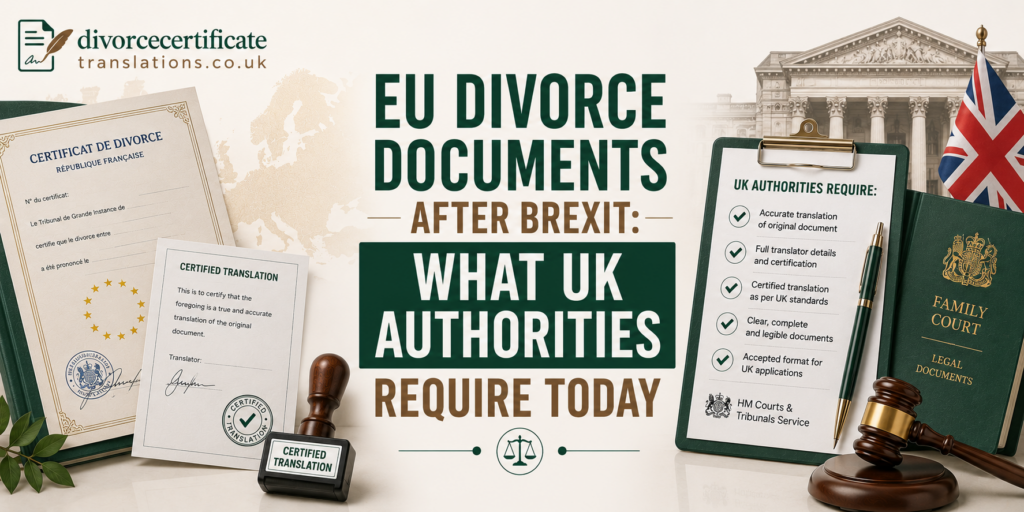
⚡ Quick Answer: Since the transition period ended at 11pm on 31 December 2020, Brussels IIa (Regulation 2201/2003) no longer applies to England and Wales, and the automatic recognition EU divorces once enjoyed here has gone. Recognition is now assessed under Part II of the Family Law Act 1986, which implemented the 1970 Hague Convention — a convention only 12 EU member states have joined. The EU Public Documents Regulation 2016/1191, which let multilingual standard forms travel between member states without apostille or translation, also stopped applying to the UK. In practice this means a full certified English translation is normally required, even where your certificate already prints English field labels.
You’re standing at a register office counter in Peterborough, Slough or Boston, holding a Polish odpis zupełny or a Romanian certificat de divorț. The form has English printed on it. You’ve used it before without a problem. And the registrar has just asked for a certified English translation.
That conversation happens across the country every week, and it always produces the same reaction: but it’s already in English. It isn’t, quite — and the reason has less to do with the document than with what changed underneath it. EU divorce certificate translation in the UK after Brexit is now governed by an entirely different legal framework from the one most people are still working to.
At Divorce Certificate Translations, our certified translators handle Polish, Romanian, Italian, Portuguese and French divorce papers for UK submissions every week. In our years of preparing these documents for Home Office compliance and register office appointments, the pattern is consistent: people aren’t careless, they’re working from rules that quietly expired.
Why The Automatic Recognition Your Document Once Enjoyed Has Gone
Under Brussels IIa, a divorce granted in one member state was recognised in the others without further formality. The UK was inside that arrangement, so a French or Polish divorce simply worked here.
That ended at 11pm on 31 December 2020. Brussels IIa was revoked for England and Wales and Northern Ireland by the Jurisdiction and Judgments (Family) (Amendment etc.) (EU Exit) Regulations 2019, surviving only for proceedings already under way at that point under the Withdrawal Agreement. The Recast regulation that replaced Brussels IIa across the EU from 1 August 2022 came in after the UK had already left, so it has never applied here at all.
What fills the gap is Part II of the Family Law Act 1986 — the same framework used for divorces from Pakistan, India or Nigeria. Your EU decree now sits in exactly the same queue as any other overseas divorce, with no shortcut.
⚠️ CRITICAL LEGAL WARNING: Only 12 EU member states are party to the 1970 Hague Convention on the recognition of divorces — Cyprus, Czechia, Denmark, Estonia, Finland, Italy, Luxembourg, the Netherlands, Poland, Portugal, Slovakia and Sweden. If your divorce was granted elsewhere in the EU, recognition depends on the general provisions of the Family Law Act 1986 rather than that convention. Whether your particular divorce is recognised is a legal question — take advice from a family law solicitor. Translation is a separate requirement and does not decide recognition either way.
Why A Bilingual Eu Certificate Still Isn’T A Translation
Here’s the part that catches almost everyone. Many EU civil registries issue multilingual extracts under CIEC Convention No. 16, and the EU Public Documents Regulation 2016/1191 added its own multilingual standard forms. Both print field labels in several languages — Nom / Surname / Cognome.
Labels are not content. What stays stubbornly in the original language is everything that carries the legal meaning: the court’s reasoning, the judge’s endorsement, the marginal annotation recording the dissolution, the registrar’s handwritten note, the round seal, the file reference. A UK caseworker can read Surname. They cannot read the annotation next to it that records when and by which court the marriage ended.
The 2016/1191 route also stopped applying to the UK after Brexit, which removed the arrangement that had made those forms travel without apostille or translation in the first place.
What court officials rarely tell you is that a partial translation often looks worse than none at all. It reads as though something has been left out deliberately.
| What your EU document already gives you | What UK authorities actually want |
|---|---|
| English field labels on a multilingual form | Every word rendered into English, including free text |
| A national civil registry extract | The document that proves the marriage legally ended, whichever that is |
| A sworn certification from an EU sworn translator | A UK-format certificate of accuracy with a named translator and contact details |
| Diacritics as issued (Ł, ș, ț, ç) | Consistent spelling that matches your passport, with variations explained |
| An EU seal or stamp | That seal and stamp translated and described, not skipped |
| Automatic recognition under the old EU regime | Evidence assessed under the Family Law Act 1986 |
Getting Your Eu Divorce Document Ready, Step By Step
Step 1 ➔ Identify which document actually proves the divorce. In several EU states you’ll hold two things: a court judgment and a civil registry extract carrying a marginal annotation. They serve different purposes. Send both to your translator and let a specialist confirm which one your authority needs before you pay for anything.
Step 2 ➔ Photograph or scan every page, including the reverse. Marginal annotations, registrar endorsements and continuation pages live on the back. We frequently see applicants get caught out because the decisive annotation was on a side nobody scanned.
Step 3 ➔ Check whether legalisation is needed on top of translation. With the EU arrangement gone, some UK submissions and some overseas onward uses now raise an apostille question that wouldn’t have arisen before 2021. FCDO apostille legalisation applies to UK-issued documents; a document issued in Poland or Italy is apostilled by that country’s competent authority. Confirm with the receiving authority before ordering.
Step 4 ➔ Don’t assume an EU sworn translation transfers. Poland’s tłumacz przysięgły, France’s traducteur assermenté and Italy’s traduzione giurata are real, regulated statuses in those countries. England and Wales has no equivalent register, so UK bodies look instead for a certificate of accuracy naming a qualified translator with contact details. A sworn certification produced abroad, in the source language, frequently gets returned here.
Step 5 ➔ Flag your name spellings before translation begins. Diacritics get dropped by UK systems, and a surname on your passport may not match the one on your decree. Tell your translator about known variations so a short note can address it, rather than leaving a caseworker to spot a discrepancy.
What Each Uk Authority Is Looking For
Register offices and the GRO want to see that a previous marriage genuinely ended before a notice of marriage can be taken. Superintendent registrars deal with EU documents constantly and are quick to spot untranslated annotations.
UKVI and the Home Office apply a stricter documentary standard again, because a divorce document supports single status, name history and relationship evidence across a whole application.
HMCTS, covering England and Wales, needs court-admissible translations that can sit in a bundle alongside the original. Scotland and Northern Ireland run separate court systems, so confirm local requirements if your matter sits there.
Frequently Asked Questions
Does My Eu Divorce Certificate Need Translating If It Already Shows English?
Usually yes. Printed English field labels don’t cover the free text, court wording, annotations or seals that carry the legal meaning, so UK authorities normally still ask for a full certified translation.
Is My Eu Divorce Still Valid In The Uk After Brexit?
Your divorce doesn’t stop existing, but it’s no longer automatically recognised here. Recognition is assessed under Part II of the Family Law Act 1986, and where there’s genuine doubt a family law solicitor should advise on your specific circumstances.
Can I Use The Sworn Translation I Already Had Done In Poland Or Italy?
Often not as it stands. Those certifications are drafted for the issuing country’s system and usually in its language. UK bodies expect a certificate of accuracy in English identifying a named translator, which is why we generally re-certify or re-issue.
Do I Need An Apostille As Well Now?
Sometimes, depending on the receiving authority and what the document will be used for. The EU arrangement that removed that step for the UK no longer applies, so check the requirement before ordering rather than after.
Will You Translate The Stamps And Seals Too?
Yes. Every stamp, seal, court emblem and handwritten annotation is rendered, with untranslatable elements described in brackets, and physical wet-ink stamps supplied where a submission calls for hard copy.
How Quickly Can An Eu Divorce Document Be Turned Around?
Standard turnaround suits most register office and visa timelines, with same-day dispatch available where an appointment or hearing is close. Send a clear scan early in the day so we can confirm your deadline is achievable.
📌 Fast, Compliant Uk Document Translation For Your Eu Divorce Papers – Get Started Now
With over a decade of certified UK translation work behind us, our in-house specialists prepare EU divorce judgments, registry extracts and annotated certificates to the exact standard British authorities expect. Every order carries our 100% Home Office and court acceptance guarantee, backed by named, qualified translators, court-admissible certification and strict confidentiality from the moment your file reaches us. Your divorce papers are personal, and they’re handled that way — total peace of mind, start to finish.
You don’t need to work out which document is the right one first. Upload a clear scan or photo of everything you’re holding, and our legal translation experts will confirm what needs translating, what doesn’t, and how fast it can be ready. Request your free instant EU translation quote today and get your paperwork settled before your appointment.
Divorce Certificate Translations
We are a UK certified translation practice working exclusively on divorce and marital-status documents — decrees, court orders, registry extracts, talaq and khula certificates — for UKVI, HM Courts and Tribunals Service, register offices, solicitors and pension trustees. Every certificate of accuracy we issue names the qualified translator who prepared it.