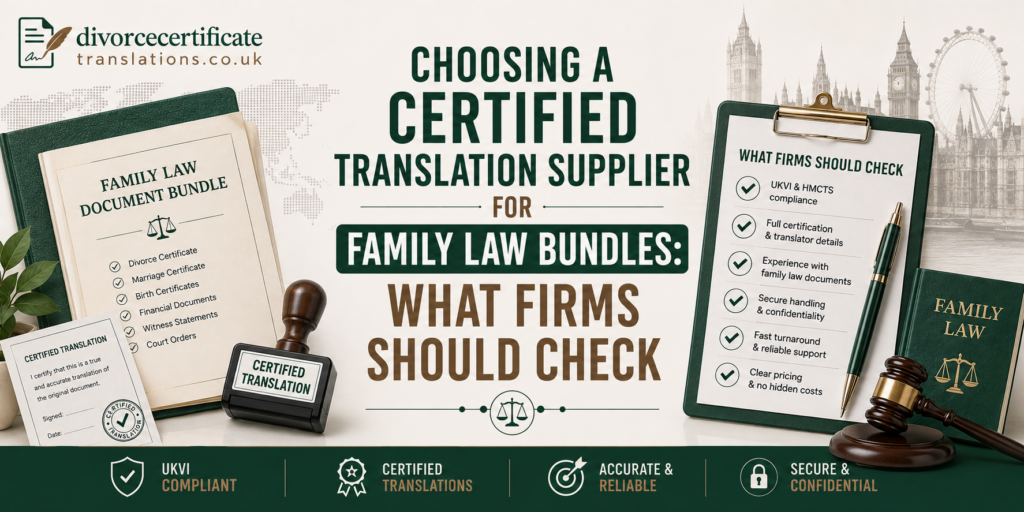
⚡ Quick Answer: Vetting a certified translation supplier in the UK means verifying five things before you instruct: that a named, qualified translator signs each certificate of accuracy; that the provider holds current professional indemnity insurance at a level appropriate to litigation work; that a written data processing agreement is in place, as UK GDPR Article 28 requires between a controller and processor; that membership of the ATC, CIOL or ITI can be independently confirmed on the relevant register; and that a committed turnaround is backed by an escalation contact. Note that England and Wales has no register of “sworn translators” — any supplier advertising sworn status here is describing a system that doesn’t exist in this jurisdiction.
Every family practice has a version of the same story. A financial remedy matter, an overseas decree, a directions deadline in nine days, and a translation ordered from whichever provider came up first. It comes back on day seven with a certificate signed “The Translation Department”, no individual named, and a supervising partner asking a question nobody can answer: who exactly stands behind this?
That’s the moment most firms realise supplier selection was a risk decision, not an admin one. Translation sits in an odd gap — too small to go through formal procurement, too consequential to buy blind. So it usually gets bought on price and speed, and the checks that matter get skipped.
At Divorce Certificate Translations, our certified translators work to instructing solicitors across England and Wales, and we’re asked to complete supplier questionnaires most weeks. The firms that ask the sharpest questions are, without exception, the ones who’ve been caught out once. Here’s what they now ask — and what you should be asking before a document lands in a bundle.
Why The Accountability Lands On Your File, Not The Supplier’S
The SRA’s Code of Conduct for Firms is clear that outsourcing work doesn’t outsource the responsibility for it. You remain accountable for the quality and confidentiality of anything produced on your client’s matter, whoever physically did it.
Practically, that means a defective translation doesn’t become the agency’s problem when it’s challenged. It becomes a question about your file — how the provider was selected, what checks were carried out, and whether a competent practitioner would have relied on them. We frequently see firms who’ve never been asked that question assume they never will be, right up until an opponent’s counsel raises an accuracy point at a directions hearing.
Common Misconceptions Vs. What Actually Holds Up
| What firms often assume | What holds up under scrutiny |
|---|---|
| “Certified” is a regulated term, so any certified provider is equivalent | It isn’t regulated in the UK. Certification standards vary enormously between suppliers |
| A company stamp on the certificate is enough | Accountability attaches to a named individual who can be identified and, if needed, questioned |
| The agency’s website says “sworn translator” so they’re higher grade | There is no sworn translator system in England and Wales — the claim signals unfamiliarity with the jurisdiction |
| An NDA covers the data position | UK GDPR requires a written processor agreement covering security, sub-processors, retention and deletion |
| Membership logos on a website prove membership | Bodies like the ATC, CIOL and ITI publish searchable registers. Check the register, not the logo |
| Cheapest quote is the commercially sensible choice | A re-translation plus an adjournment costs many multiples of the original fee |
💡 PRO TIP: Ask any prospective supplier for a redacted sample certificate of accuracy before you instruct. Thirty seconds reading their actual wording tells you more than an hour on their website.
The Seven Questions Worth Asking Before You Instruct
Who Signs The Certificate, And Can You Speak To Them?
The single most useful question. You want a named translator with stated qualifications and contact details, not a departmental signature. If a point is raised about a rendering six months later, a named professional can address it. A generic company slip leaves you with nothing to put forward.
Does A Second Linguist Check The Work?
A translator reviewing their own output catches far less than an independent reviser. ISO 17100 builds that second pass into the standard, which is why it’s worth asking about even where formal certification isn’t essential to you. For divorce decrees the review matters most on names, dates and jurisdiction-specific court terminology.
What’S Their Professional Indemnity Position?
Ask for the certificate and check the limit of indemnity, the renewal date and whether any liability cap in their terms would leave you exposed. Some suppliers cap liability at the value of the invoice — meaning a £90 translation carries £90 of protection against a failed hearing. That’s worth knowing before, not after.
How Is Your Client’S Data Actually Handled?
Your firm is the controller and the provider is the processor, so a written agreement covering security, sub-processors, retention and deletion isn’t optional. Ask where files are stored, whether work is subcontracted offshore, how documents are transferred, and when they’re deleted. Divorce papers carry financial detail, children’s names and addresses — material you’d never email unencrypted internally.
Can They Evidence A Turnaround, Not Just Promise One?
Anyone can say same-day. Ask what their cut-off time is, what happens if your document arrives at 4pm, whether they offer out-of-hours cover, and who you escalate to when the person handling it is off. A named account contact is worth more than a marketing claim.
What’S The Amendment Policy In Writing?
Errors happen in every profession. What separates suppliers is what follows. You want a written commitment to correct genuine errors at no charge and to re-issue quickly — and you want to know that before there’s a deadline and a disagreement.
Will The Invoice Survive A Costs Assessment?
If translation is recoverable as a disbursement, the paperwork needs to hold up. Ask for itemised invoicing showing document, language pair, page or word count and turnaround, with your matter reference on it. On legal aid work, check current LAA guidance on whether prior authority is required for the amount involved before you commit.
💡 PRO TIP: Run a low-stakes trial instruction on a non-urgent matter before adding anyone to your panel. You’ll learn more from one real job than from any credentials pack.
Your Pre-Instruction Checklist
- Named translator with qualifications and contact details on the certificate
- Membership verified on the ATC, CIOL or ITI register — not taken from a logo
- Sample certification wording reviewed and shared with your supervising fee earner
- Current PII certificate obtained; limit of indemnity and liability cap checked
- Written data processing agreement and NDA in place before any file is sent
- Secure transfer method confirmed; retention and deletion periods agreed
- Turnaround, cut-off time, out-of-hours cover and escalation contact documented
- Amendment and error-correction policy confirmed in writing
- Itemised invoicing format agreed, with matter reference and account terms
- Confirmation they can supply wet-ink signed hard copy as well as searchable PDF for e-bundles
Frequently Asked Questions
Is “Certified Translation” A Regulated Status In The Uk?
No. There’s no statutory register of certified translators in England and Wales, which is exactly why supplier vetting falls to you. What varies is the certification wording, the qualifications behind it, and whether an individual is willing to be named on it.
Do We Need An Iso-Certified Provider For Family Work?
Not as an absolute requirement, but ISO 17100 tells you a second-linguist review is built into the process rather than offered as an upsell, and ISO 27001 tells you information security has been externally audited. Both shorten your due diligence considerably.
Can We Send Documents Before A Data Processing Agreement Is Signed?
You shouldn’t. The agreement is what governs security, sub-processing and deletion of your client’s personal data. Any established provider will have one ready to sign the same day, so it rarely delays anything.
Should We Use One Panel Supplier Or Several?
Most family practices we work with keep a primary supplier and one backup for capacity and unusual language pairs. What matters is that both have been through the same checks, rather than one being vetted and the other being whoever answered the phone.
Does This Guidance Apply Across The Uk?
The regulatory references here are to the SRA, which regulates firms in England and Wales. Practices in Scotland and Northern Ireland are regulated separately, though the commercial and data protection checks apply equally.
How Far Ahead Of A Bundle Deadline Should We Instruct?
Build in time for you to check names and dates against the file before anything is paginated. Where a document is long, multilingual or badly scanned, the realistic constraint is usually your own review window rather than the translator’s.
📌 Protect Your File: Add A Verifiable Translation Supplier To Your Panel
Our in-house specialists prepare foreign divorce decrees, consent orders and settlement agreements for instructing solicitors across England and Wales, and we’re set up for the way firms actually buy. Every certificate of accuracy carries a named, qualified translator with contact details. Our legal translation experts can supply our PII certificate, data processing agreement and NDA before you send a single file, alongside wet-ink signed hard copies or searchable PDFs for e-bundles, itemised invoicing against your matter reference, and genuine errors corrected at no charge.
Start with something small rather than a credentials pack you’ll never read. Send us one non-urgent decree with your deadline and matter reference, and see how the certification, turnaround and invoicing actually look on your file. You can request a fixed-fee quote for your first matter today, with account terms available once you’re satisfied.
Divorce Certificate Translations
We are a UK certified translation practice working exclusively on divorce and marital-status documents — decrees, court orders, registry extracts, talaq and khula certificates — for UKVI, HM Courts and Tribunals Service, register offices, solicitors and pension trustees. Every certificate of accuracy we issue names the qualified translator who prepared it.