⚡ Quick Answer: Changing your name in the UK after an overseas divorce usually doesn’t require a deed poll. Reverting to your maiden name is generally evidenced with your birth certificate, your marriage certificate and your final divorce document — and where any of those were issued abroad in another language, UK bodies including HM Passport Office and UKVI expect a certified English translation carrying the translator’s name, signature and contact details. The most common cause of rejection isn’t a missing document but a name discrepancy: transliteration from Cyrillic, Arabic or Urdu script, dropped diacritics such as Ł, ș, ț and ñ, patronymics, feminine surname endings, or Spanish and Portuguese double surnames. The fix is an accurate translation with a translator’s note explaining the variant — not a new legal name.
Your passport says one thing. Your marriage certificate says something slightly different. Your divorce decree, issued in another country, says a third version. And now someone at a counter is looking at all three and asking you to explain.
If that’s where you are, you haven’t done anything wrong. Names travel badly between languages and legal systems, and nobody warns you about it until you’re standing there trying to prove you’re one person.
At Divorce Certificate Translations, our certified translators handle this every week — and the fix is almost always simpler and cheaper than people expect. Here’s what’s actually happening, and how to sort it.
Why The Names Don’T Line Up, And Why It’S Rarely Your Fault
A name isn’t copied between documents. It’s re-recorded, often by different officials, in different scripts, under different naming conventions. Each step introduces drift:
- Script conversion. Cyrillic, Arabic, Urdu and Greek names have no single correct romanisation. Юлия is Yulia, Yuliya or Julia depending on who typed it.
- Dropped diacritics. UK systems often can’t store Ł, ș, ț, ñ, ç or ø, so the marks vanish and the name shifts.
- Grammatical endings. Polish, Czech, Slovak, Russian and Romanian surnames change form by gender — Nowak becomes Nowaka, Popescu becomes Popescu but Ivanov becomes Ivanova.
- Compound surnames. Spanish and Portuguese records carry two surnames. UK forms have one box, so half the name gets quietly dropped.
- Name order. Some registries print the family name first. Transcribed into a UK form, given name and surname swap places.
- Married name never registered abroad. Many countries don’t change a woman’s surname on marriage at all, so her home-country records still show her birth name while her UK records show her married one.
We frequently see applicants assume a mismatch means something is legally wrong with their divorce. It almost never does. It means two documents were written by two people who transliterated the same name differently.
Common Misconceptions About Changing Your Name After A Divorce Abroad
| What people assume | What’s actually the case |
|---|---|
| “I need a deed poll to go back to my maiden name” | Generally not. Reverting is usually evidenced by birth, marriage and divorce documents together |
| “The translator should correct my name to match my passport” | No. A certified translation must render the name exactly as printed, then explain any variant in a note |
| “My divorce isn’t valid here because the name doesn’t match” | Recognition is a separate legal question entirely, unconnected to spelling |
| “A friend who speaks the language can translate it” | UK bodies expect certification from a named, contactable translator with stated credentials |
| “One document is enough” | Most bodies want the chain: birth name ➔ married name ➔ divorce ➔ reverted name |
| “I’ll fix it later once the passport is done” | Each record you update on the wrong spelling makes the next one harder to correct |
💡 PRO TIP: Before you order anything, write out every spelling of your name that appears across your documents, exactly as printed. That one list will tell your translator precisely which variants need addressing — and it’s the single most useful thing you can do.
Do You Actually Need A Deed Poll?
For most people reverting to a maiden name in England and Wales, no. What you’re doing isn’t adopting a new name; you’re returning to the one on your birth certificate, and the documents you already hold evidence that.
A deed poll or statutory declaration becomes relevant in narrower situations — taking a name you’ve never legally held, adopting a hybrid or double-barrelled surname, or where a body specifically asks for one because the evidence chain has a gap. Some people also choose to enrol a deed poll for a permanent public record, though that’s optional rather than required.
Scotland and Northern Ireland handle name recording through their own registration systems, so confirm the position locally if you’re there rather than assuming the England and Wales approach applies.
Building An Evidence Chain Uk Bodies Will Accept
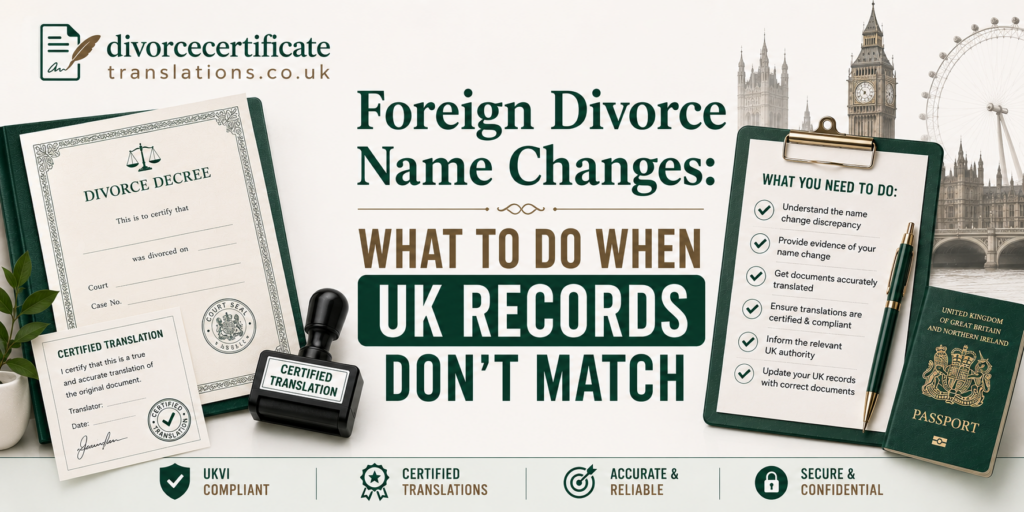
What HM Passport Office, UKVI and register offices are really doing is following one continuous thread from the name you were born with to the name you’re asking them to record now. Every link needs to be readable and certified.
Your birth certificate establishes the starting name. Your marriage certificate shows the change. Your final divorce document — a decree absolute, final order, court judgment or civil registry extract, depending on the country — shows the marriage ended. Where any of these is in another language, it needs a full certified English translation, including stamps, seals and marginal annotations, not just the printed text.
What officials rarely tell you is that the translator’s note carries real weight here. A short, clear line confirming that two spellings represent the same name, and explaining why, resolves at a glance what would otherwise become a query. That note is the difference between an application that proceeds and one that comes back.
Whether a translation also needs notarisation or an apostille depends on the receiving body, so ask them before paying for either. If your documents come from an EU country, there are some specific quirks worth knowing about which form you’ve actually been issued.
Your Before-You-Apply Checklist
- Every spelling of your name written out exactly as printed on each document
- Birth certificate located, complete and legible on both sides
- Marriage certificate located, including any marginal annotation recording the divorce
- Final divorce document identified — not an interim or provisional order
- All foreign-language documents scanned in full, including stamps and reverse sides
- Receiving body asked whether notarisation or an apostille is required
- Name variants flagged to your translator before work begins
- Certified translations carry the translator’s name, signature and contact details
- Order of applications decided — passport first, then everything that depends on it
- Copies kept of everything submitted, in case a second body asks
💡 PRO TIP: Sequence matters more than speed. Get your passport corrected first, because most other records — DVLA, HMRC, banks, pension providers — will accept it as identity evidence, and you’ll avoid repeating the document exercise five times.
Frequently Asked Questions
Do I Need A Deed Poll If My Divorce Was Granted Abroad?
Usually not. Reverting to your maiden name is normally evidenced by your birth, marriage and divorce documents together, with certified translations where any are in another language. A deed poll matters mainly for names you’ve never legally held.
My Passport Spelling Differs From My Divorce Certificate. Will That Be Rejected?
Not if it’s explained. The translation must reproduce the name exactly as printed on the original, with a translator’s note confirming that the spellings refer to the same person and why they differ.
Can The Translator Just Use My Passport Spelling Instead?
No, and you wouldn’t want one who would. Altering a name to match another document undermines the certification, which confirms the English version matches the original. The variant is documented, not edited away.
Which Divorce Document Do I Need Translated?
The one showing the divorce is final. Country to country that might be a decree absolute, a final order, a court judgment or a civil registry extract with the dissolution annotated. Send us what you have and our specialists will confirm which is relevant.
Does My Name Change Affect Whether My Divorce Counts In The Uk?
No. Recognition of an overseas divorce is a separate legal question, decided on where and how the divorce was obtained. Take advice from a family law solicitor if that’s genuinely in doubt.
Can I Use The Same Translation For The Passport Office And A Visa Application?
Usually yes. The underlying documents don’t change, so a properly certified translation can normally support more than one application. Confirm with each body if their guidance differs.
📌 Sort Your Name Records Properly: Get Your Documents Translated Today
Our in-house specialists prepare certified translations of foreign birth, marriage and divorce documents for HM Passport Office, UKVI and register offices across the UK. Every certificate of accuracy names the qualified translator who prepared it, with their signature and contact details, and where your spellings differ across documents, our legal translation experts add a clear translator’s note explaining the variant so officials aren’t left guessing. Genuine errors are corrected at no charge, and your documents stay strictly confidential from start to finish.
You don’t need to work out which document matters first. Send clear scans of what you’re holding, tell us which body you’re applying to, and our certified translators will confirm exactly what needs translating and what doesn’t. You can get your name discrepancy reviewed and quoted free today, with same-day dispatch available where an appointment is already booked.
Divorce Certificate Translations
We are a UK certified translation practice working exclusively on divorce and marital-status documents — decrees, court orders, registry extracts, talaq and khula certificates — for UKVI, HM Courts and Tribunals Service, register offices, solicitors and pension trustees. Every certificate of accuracy we issue names the qualified translator who prepared it.