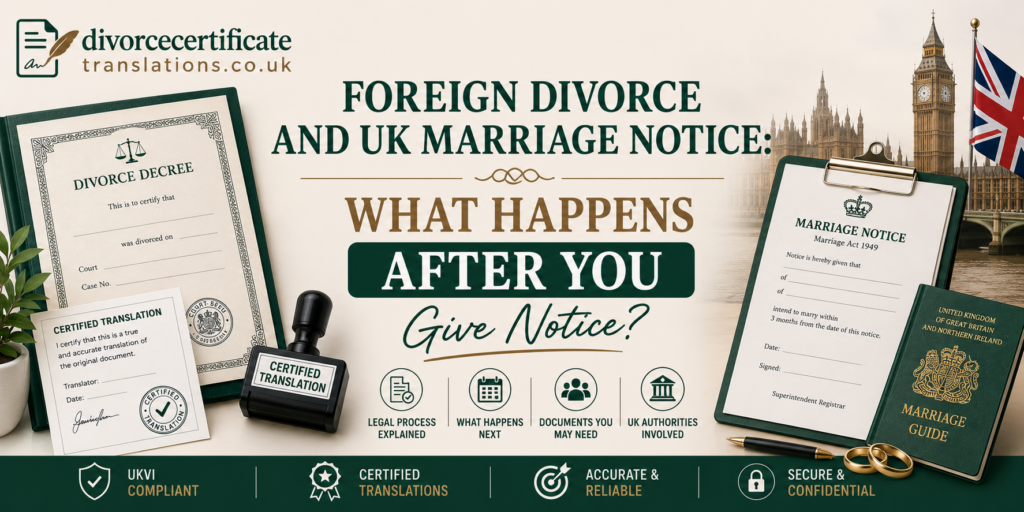
⚡ Quick Answer: When you give notice of marriage in England or Wales and a previous marriage ended abroad, the superintendent registrar must consider whether that foreign divorce is recognised here under Part II of the Family Law Act 1986. A separate statutory consideration fee applies, and for divorces from certain countries the registrar must refer the papers to the General Register Office for approval, which carries a further statutory fee — check your register office’s current published figures, as these are revised periodically. Your marriage cannot legally proceed until clearance is granted, and this runs alongside the standard 28-day notice period rather than inside it. Any foreign divorce document not in English must be submitted with a full certified translation, and incomplete translations are one of the most common causes of delay.
You gave notice. You brought everything on the list. And then the registrar said something you weren’t expecting: your divorce needs to be considered, there’s an extra fee, and it may have to go to the General Register Office.
Meanwhile your venue is booked, the deposit is gone, and nobody can tell you how long this takes.
If that’s where you are, take a breath — this is a normal administrative step, not a sign that something is wrong with your divorce. At Divorce Certificate Translations, our certified translators prepare foreign divorce documents for notice appointments across the country, and we see this process play out constantly. Here’s what’s actually happening and, more usefully, which parts of it you can influence.
Why A Foreign Divorce Gets Checked When A Uk One Doesn’T
A decree absolute or final order issued by a court in England or Wales needs no assessment. The registrar can see on its face that it came from a UK court and that the marriage legally ended.
A foreign divorce carries no such built-in assurance. Before your notice can lead to a marriage, the registrar must be satisfied you’re legally free to marry — which means being satisfied that the overseas divorce is recognised under English law. That’s a legal judgement, not a filing exercise, and it’s why a separate consideration fee exists.
Where the position isn’t clear-cut, the registrar doesn’t decide alone. The papers go to the General Register Office, which reviews them and grants or withholds clearance. Referrals are more common with certain countries and certain types of divorce, though the registrar makes that call case by case.
What Is Actually Being Assessed
Recognition under Part II of the Family Law Act 1986 turns largely on how the divorce was obtained. Divorces obtained by means of proceedings — a court process, or a formal procedure before a recognised body — are more straightforward, provided the divorce was effective in that country and one of you was habitually resident, domiciled or a national there at the time.
Divorces obtained other than by means of proceedings attract closer scrutiny. This category includes some religious and customary dissolutions, and the conditions are stricter. There’s also the transnational problem: a divorce that began in one country and completed in another is generally not recognised here. If your circumstances fall into this territory, a family law solicitor is worth speaking to early rather than after a refusal.
None of this is about your document being “good” or “bad”. It’s about a legal test applied to how the divorce happened.
⚠️ CRITICAL LEGAL WARNING: Do not treat a booked venue as a safe date. Register offices state plainly that if you make ceremony arrangements before your documents are cleared, neither the register office nor the General Register Office accepts liability for costs if the wedding cannot go ahead. Book refundable where you can, and tell your venue that clearance is pending.
Uk Decree Versus Foreign Divorce At The Notice Appointment
| At your notice appointment | UK decree absolute or final order | Divorce granted abroad |
|---|---|---|
| Additional statutory fee | None | A consideration fee applies, plus a further fee if referred to the GRO |
| Who assesses it | Accepted on its face by the registrar | Registrar, and the General Register Office where referred |
| Legal question involved | None | Whether the divorce is recognised under the Family Law Act 1986 |
| Translation required | Not applicable | Full certified English translation of every page |
| Effect on your timeline | Standard 28-day notice period | Notice period runs, but the ceremony waits for clearance |
| Predictable duration | Yes | No published timescale — it depends on the case |
What Happens After You Give Notice, Step By Step
Step 1 ➔ Your notice is entered and displayed. The statutory 28-day waiting period begins and your notice goes on public display at the register office. Notice generally remains valid for twelve months, which matters if clearance pushes your date back — you usually won’t need to start again.
Step 2 ➔ The registrar examines your divorce documents. Your final divorce document and its certified English translation are read together. What our specialists are asked to fix most often at this stage is an incomplete translation — a reverse side left out, court seals and registrar endorsements untranslated, or a marginal annotation missed entirely. Every element on the page forms part of the record.
Step 3 ➔ The registrar either accepts it or refers it. If the position is clear, the matter ends there. If not, the papers go to the General Register Office with the additional fee. We frequently see couples treat a referral as a rejection. It isn’t — it’s a second, more specialist pair of eyes.
Step 4 ➔ The General Register Office reviews and decides. There’s no published service standard, and duration varies with the country, the document type and how complete the file is. What you can control is completeness: a clean, fully certified translation gives the reviewer nothing to query and no reason to write back asking for more.
Step 5 ➔ Clearance is granted and your paperwork is issued. Only once cleared can the authority for your marriage be issued and the ceremony go ahead. If clearance is refused, take legal advice quickly — there are routes available, including a court declaration as to marital status, but they take time.
The Parts You Can Actually Control
You can’t speed up the GRO. You can remove every reason for it to slow down:
- Supply the final divorce document, not an interim or provisional order — send us what you have and our legal translation experts will confirm which it is.
- Scan every page, both sides, including stapled annexes and anything handwritten in the margins.
- Have stamps, seals and endorsements translated as part of the document, with untranslatable elements described in square brackets.
- Flag name spelling differences between your passport and your decree up front, so a translator’s note explains the variant rather than leaving a reviewer guessing.
- Ask the register office whether they also want the document notarised or apostilled — requirements differ and you may be paying for something you don’t need.
- If your divorce came from an EU country, be aware the documents you were issued may not be the ones you assume, and bilingual forms are not translations.
Frequently Asked Questions
How Long Does Foreign Divorce Clearance Take?
There’s no published timescale. It depends on the country, the type of divorce and whether the file is complete. Ask your register office for a realistic indication for your case, and avoid non-refundable bookings until clearance comes through.
Can I Book My Wedding Before My Divorce Has Been Cleared?
You can, but at your own financial risk. Register offices are explicit that they accept no liability if a ceremony can’t proceed because clearance hasn’t been granted.
Does The 28-Day Notice Period Include The Clearance Time?
No. The notice period runs on its own statutory timetable, but the marriage still can’t take place until clearance is granted. The two aren’t the same thing and one doesn’t cover the other.
Why Was My Divorce Referred When My Friend’S Wasn’T?
Referral depends on the country of origin and how the divorce was obtained, not on anything you’ve done. Some jurisdictions and some divorce types are referred routinely.
Will A Better Translation Make My Divorce Recognised?
No, and be cautious of anyone suggesting otherwise. Recognition is a legal question about how the divorce happened. What an accurate, complete certified translation does is ensure the decision is made on the full facts rather than on a partial document.
Does This Apply In Scotland And Northern Ireland?
The process described here is for England and Wales. Scotland works through National Records of Scotland and Northern Ireland through GRONI, each with their own requirements, so check locally.
📌 Fast, Compliant Divorce Translations – Get Your Notice Documents Ready Now
Our in-house specialists prepare certified translations of foreign divorce decrees, court judgments, civil registry extracts and talaq or Union Council certificates for notice of marriage appointments across England and Wales. Every certificate of accuracy names the qualified translator who prepared it, with signature and contact details, and every stamp, seal and marginal annotation is translated so a registrar or GRO reviewer sees the complete picture. Genuine errors are corrected at no charge, and your documents stay strictly confidential throughout.
If clearance is already underway, a complete translation is the one part of this you can still fix. Send a clear scan of your divorce document and tell us your notice date — our certified translators will confirm what’s needed before you spend anything. You can get your notice documents checked and quoted free today, with same-day dispatch available when a ceremony date is close.
Divorce Certificate Translations
We are a UK certified translation practice working exclusively on divorce and marital-status documents — decrees, court orders, registry extracts, talaq and khula certificates — for UKVI, HM Courts and Tribunals Service, register offices, solicitors and pension trustees. Every certificate of accuracy we issue names the qualified translator who prepared it.